


Value Investing Remains Effective in India with Careful Stock Selection

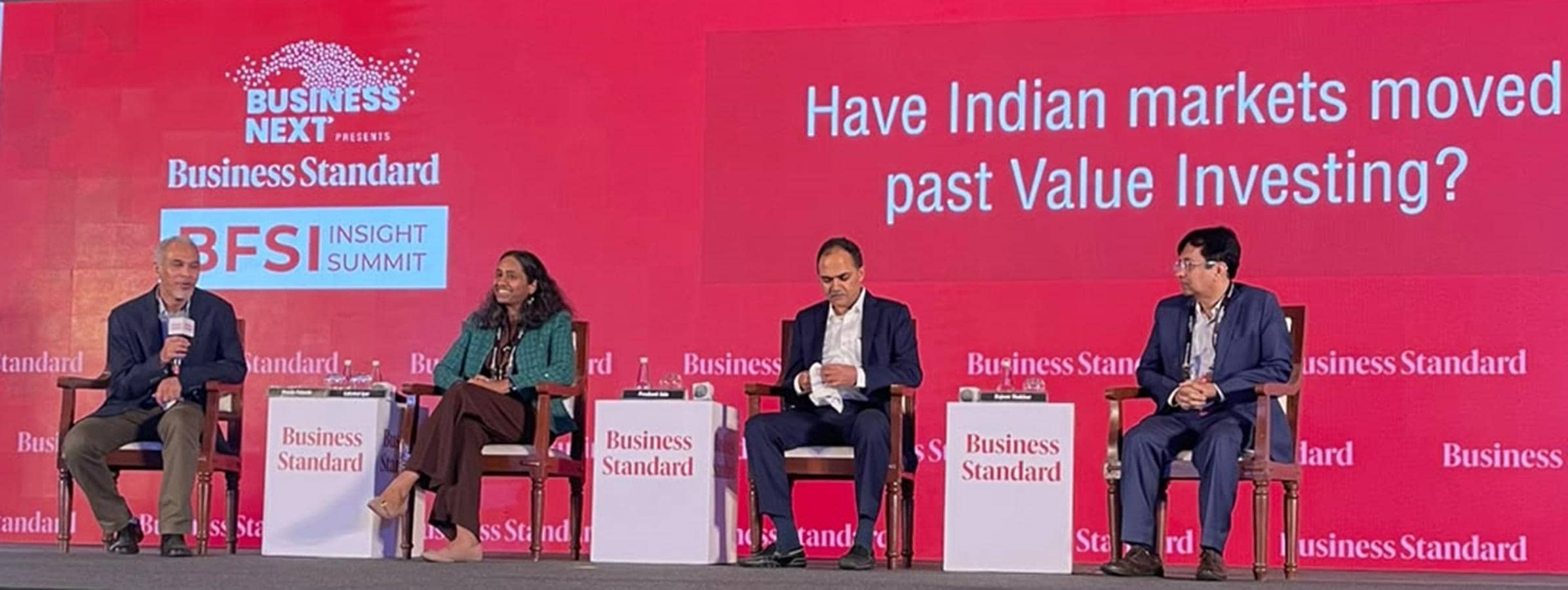


Value investing continues to hold significance in the Indian stock market, but investors must carefully distinguish between stocks that are genuinely undervalued and those whose prices have dropped due to weakening business fundamentals. This was the consensus among fund managers gathered at the Business Standard BFSI Summit in Mumbai on Wednesday.




The session titled 'Have Indian markets moved past Value Investing?', moderated by Business Standard's Praveen Palande, featured key insights from industry veterans. Rajiv Thakkar, chief investment officer for equity and director at PPFAS Asset Management, emphasized the importance of assessing a company's intrinsic worth rather than simply labeling stocks as either value or growth.
Thakkar explained that successful investing involves comparing a company’s true value to its current market price. He cited his experience with US technology stocks, where conventional valuation methods revealed market prices that did not accurately reflect intrinsic values. This approach underlines a fundamental difference between value and growth investing: growth investors tend to focus heavily on potential earnings far in the future, while value investors prefer cash flows that are more immediate and visible.
He warned against relying too much on long-term projections due to the risk of inaccuracies, referencing the challenges faced when valuing certain Indian technology firms. Thakkar also highlighted the critical role of corporate governance. Despite regulatory enhancements and better disclosure, investors sometimes overlook questionable track records of promoters, which can pose risks.
Prashant Jain, founder and chief investment officer at 3P Investment Managers, shared his perspective on the emotional and analytical aspects of investing. Jain pointed out that sticking with a stock during extended periods of underperformance requires not just intelligence but emotional intelligence—a deep understanding of the business and conviction in one’s analysis. He recounted his decision to exit Indian technology stocks in November 1999 due to unsustainable valuations, though he affirmed that the sector remains important in India’s economy.
Jain noted that despite potential cost pressures from artificial intelligence adoption, Indian tech companies continue to grow their dollar revenue, underscoring their ongoing relevance in the market.
Adding to the discussion, Lakshmi Iyer, group president for investments and MD & CEO of Bajaj Alternate Investment Fund Managers, pointed out that value investing principles can apply across different asset classes, including fixed income. Fund managers must assess which sectors or instruments are likely to offer better returns based on the current market phase.
Regarding artificial intelligence, Iyer contrasted India’s landscape with that of the United States. While US investments heavily focus on foundational AI infrastructure and large language models, Indian companies tend to concentrate on application-based AI solutions. She dismissed concerns of a bubble in India’s AI sector, noting that domestic firms have generally avoided excessive borrowing and fund capital expenditures through cash flow.
For publicly traded Indian technology companies, Iyer advised greater selectivity. She cautioned investors that not all discounted stocks represent good value; it is essential to discern whether price drops signal temporary challenges or a longer-term decline in business prospects.
Rajiv Thakkar also discussed valuation differences among market segments. Large-cap stocks trade at lower price-to-earnings multiples compared to mid-cap and small-cap stocks. He cited approximate PE ratios: 18-19 for the Nifty 100, 24-25 for the Nifty Midcap 150, and 31-32 for the Nifty Smallcap 250. Despite some outflows from large-cap funds, domestic money has been flowing into mid- and small-cap mutual funds, suggesting investors may be overly concentrated in smaller companies.
Thakkar underscored that the top 100 companies contribute around 65 to 70 percent of the earnings among India’s top 500 listed firms. This makes it important not to disregard larger companies even when their stock performance lags.
Jain agreed that market cycles may shift relative performance across segments but stressed that not all small- and mid-cap firms are equal. He emphasized that large-cap stocks can offer value, sustainability, and growth, and should remain part of investors’ focus. Meanwhile, smaller companies require careful research and selectivity to identify worthwhile opportunities.
Concluding the discussion, Iyer recommended a balanced investment approach that does not exclude any market segment. She urged investors to look beyond headline index movements and popular narratives, focusing instead on companies with strong fundamentals and reasonable valuations to find true value in the Indian market.
What's Your Reaction?
 Like
0
 Dislike
0
 Love
0
 Funny
0
 Wow
0
 Sad
0
 Angry
0














Comments (0)