


Fairfax to Acquire 60.72% Stake in IDBI Bank Under RBI Rules

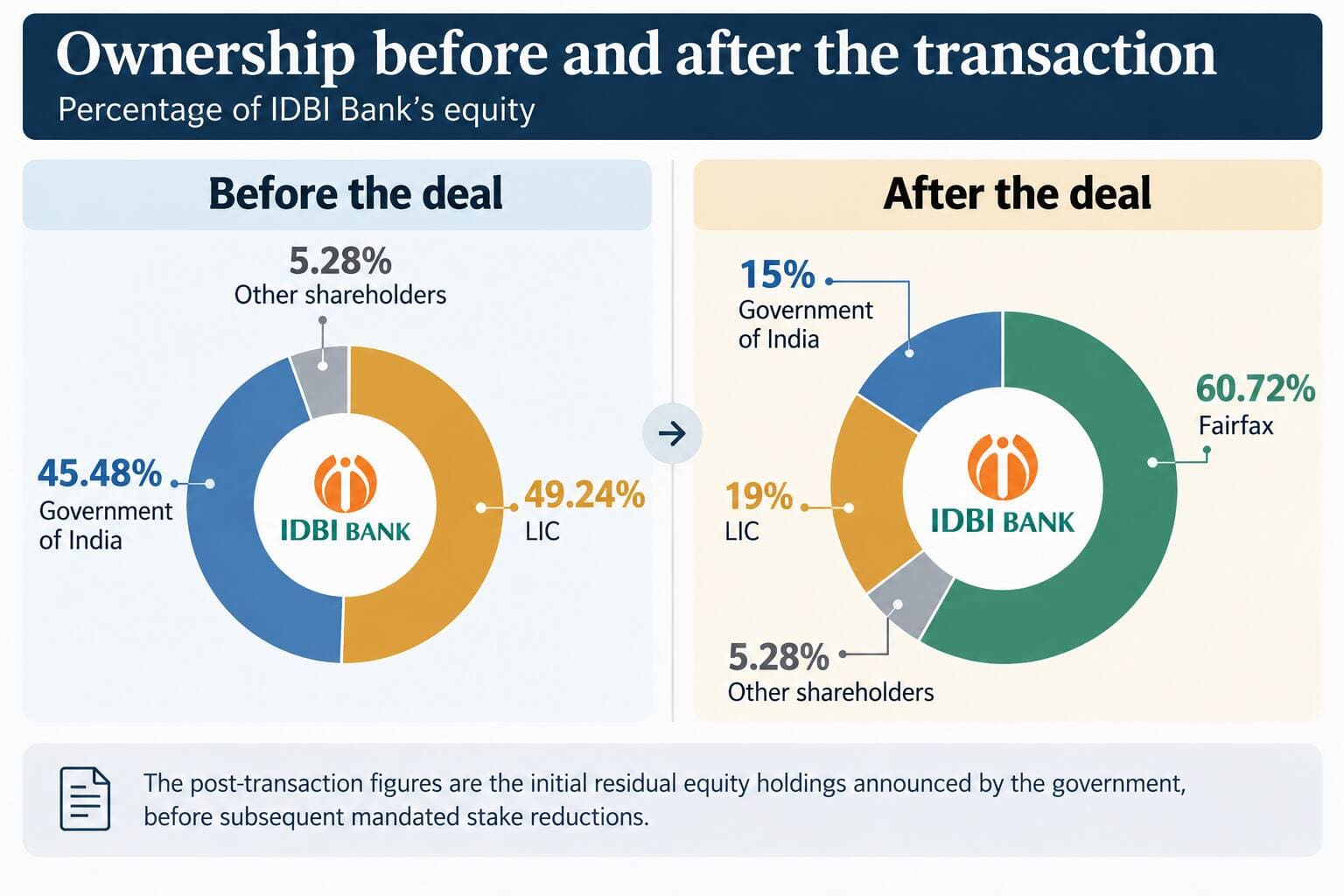


Canada's Fairfax Financial Holdings is poised to take control of a 60.72 percent stake in IDBI Bank for ₹52,878 crore, following approval from India’s Cabinet Committee on Economic Affairs (CCEA) on Wednesday. While this government nod clears a major hurdle, the transaction still awaits regulatory clearances and completion of procedural formalities.




The acquisition highlights the regulatory framework India applies to foreign investment in its banking sector. The Reserve Bank of India (RBI) places specific limits on foreign ownership, voting rights, and promoter shareholding to maintain financial stability and control within Indian banks.
Background on Foreign Investment in Indian Banks
India allows foreign direct investment (FDI) in private sector banks up to 49 percent via the automatic route, meaning no prior government approval is needed. However, investments above 49 percent and up to 74 percent require explicit government permission. For public sector banks, the FDI cap is significantly lower at 20 percent, and this too requires government approval.
IDBI Bank’s classification changed after Life Insurance Corporation of India (LIC) acquired a controlling interest in 2019, shifting it from a public sector to a private sector bank under RBI’s definitions. This reclassification means the Fairfax deal is governed by the rules applicable to private banks rather than the stricter 20 percent FDI ceiling for public sector banks.
RBI’s Regulatory Framework on Ownership
The RBI enforces ownership regulations to ensure that entities controlling banks are financially robust, have transparent sources of funds, and can be effectively supervised. Under the Banking Regulation Act of 1949, any major shareholder must receive RBI approval before acquiring significant shares.
The RBI’s January 2023 Master Direction on acquisition and holding of shares details the process for assessing prospective shareholders. The regulator looks into the financial strength, business reputation, and corporate structure of the investors, including ultimate beneficial owners and related parties that might exert control.
Ownership is dissected into three key components: equity ownership, voting rights, and control. Equity refers to the economic stake, voting rights determine influence over shareholder decisions, and control involves the ability to affect board appointments, management, and strategic direction.
Details of the Fairfax-IDBI Bank Deal
While Fairfax is set to acquire a 60.72 percent equity stake, RBI rules require this holding to be trimmed to 26 percent within 15 years. This timeline aligns with recommendations from the RBI’s 2020 Internal Working Group, which suggested gradual dilution of promoter stakes to balance ownership and regulatory oversight.
In addition to the equity cap, voting power is capped at 26 percent despite Fairfax’s larger shareholding. This separation ensures that no single investor can wield unchecked influence purely due to equity size. Banks, unlike regular companies, have significant economic and social importance, which justifies these ownership limits.
Post-transaction, the government and LIC are expected to retain stakes of approximately 15 percent and 19 percent respectively. Both parties plan to withdraw their board representatives, paving the way for Fairfax’s increased role in governance.
One complexity that arises from Fairfax’s acquisition is its existing stake in CSB Bank. RBI will require Fairfax to address potential conflicts or overlapping interests between its holdings in multiple banking entities, consistent with regulatory safeguards.
The Broader Banking Sector Context
India’s banking sector has been gradually opening to foreign investment under controlled conditions to attract capital and expertise while preserving systemic stability. The Fairfax-IDBI deal exemplifies this approach, allowing foreign majority ownership within a regulated framework that limits voting power and mandates phased dilution.
Such policies aim to balance the benefits of foreign investment—such as stronger capital bases and improved governance—with the need to maintain regulatory oversight and protect the public interest in the banking system.
As Fairfax moves forward with this significant investment, its compliance with RBI’s fit-and-proper criteria and adherence to ownership caps will be closely watched. The transaction sets a precedent for large-scale foreign participation in private sector banks, reflecting India’s evolving financial regulatory landscape.
What's Your Reaction?
 Like
0
 Dislike
0
 Love
0
 Funny
0
 Wow
0
 Sad
0
 Angry
0

















Comments (0)