


Uttar Pradesh EV Manufacturing and Mobility Policy, 2022: Things to know



POLICY AT A GLANCE
| Item | Position |
| Official title | Uttar Pradesh Electric Vehicle Manufacturing and Mobility Policy, 2022 |
| Notification date | October 14, 2022 |
| Policy validity | Five years from notification, subject to amendments |
| Nodal department | Infrastructure and Industrial Development Department, Uttar Pradesh |
| Manufacturing nodal agency | Invest UP |
| Main manufacturing categories | Electric vehicles, EV components, batteries, battery components, charging equipment and related manufacturing |
| Highest capital subsidy | 30 per cent of eligible fixed capital investment, capped at Rs 1,000 crore for specified first Integrated EV and Ultra-Mega Battery projects |
| Mega-project subsidy | 20 per cent, capped at Rs 500 crore |
| Large-project subsidy | 18 per cent, capped at Rs 90 crore |
| MSME subsidy | 10 per cent, capped at Rs 5 crore |
| Charging-station support | 20 per cent of eligible fixed capital investment, capped at Rs 10 lakh |
| Battery-swapping support | 20 per cent, capped at Rs 5 lakh |
| Other manufacturing incentives | Stamp-duty reimbursement, certification, patent and skill-development assistance |
| EV adoption support | Purchase subsidy plus road-tax and registration-fee exemptions under prescribed conditions |
| Current status | Operative within its five-year period and amended subsequently, including changes announced in 2025 |
The policy replaced the Uttar Pradesh Electric Vehicle Manufacturing and Mobility Policy, 2019. Its three principal pillars are EV manufacturing, charging infrastructure and faster adoption of electric vehicles.




What is the Uttar Pradesh EV Manufacturing and Mobility Policy?
The policy is a combined industrial and transport framework intended to develop an electric-vehicle ecosystem in Uttar Pradesh.
On the supply side, it supports manufacturing of:
- Electric vehicles;
- Electric-vehicle components;
- EV batteries;
- Battery components;
- Charging equipment;
- Battery-swapping equipment;
- Associated testing and research facilities.
On the demand side, it provides incentives to encourage consumers and fleet operators to purchase electric vehicles. It also supports the creation of public charging and battery-swapping infrastructure.
Also Read
The policy therefore differs from a conventional automobile-manufacturing scheme. It covers the full ecosystem — from production and batteries to charging and final vehicle adoption.
Why was the policy introduced?
Uttar Pradesh had already introduced an EV policy in 2019, but the state concluded that rapid changes in electric mobility, battery technology and Union government support required a new framework.
The 2022 policy aims to:
- Make Uttar Pradesh a major EV and electric-mobility manufacturing hub;
- Attract manufacturers across the EV value chain;
- Encourage investment in EV batteries and components;
- Accelerate replacement of internal-combustion-engine vehicles;
- Develop charging and battery-swapping infrastructure;
- Promote research in battery-management systems, drivetrains, battery chemistry, fuel cells and EV electronics;
- Generate manufacturing and technical employment.
The policy is valid for 60 months from its notification, making the original effective period run from October 14, 2022, subject to amendments issued by the state government.
Which manufacturing projects are eligible?
The policy divides eligible manufacturing projects by investment size and activity.
Integrated EV Project
An Integrated EV Project must manufacture at least two of the following:
- Electric vehicles;
- EV batteries;
- EV or battery components;
- Testing and research and development facilities.
It must have eligible fixed capital investment of at least Rs 3,000 crore. The project may be established by one company, a group of companies or a consortium.
Ultra-Mega Battery Project
An Ultra-Mega Battery Project must have:
- Eligible fixed capital investment of at least Rs 1,500 crore; and
- Minimum battery-production capacity of 1 gigawatt-hour.
Mega EV Project
A Mega EV Project is an EV or EV-component manufacturing unit with eligible fixed capital investment of at least Rs 500 crore.
Mega EV Battery Project
A Mega EV Battery Project must invest at least Rs 300 crore in eligible fixed capital investment in batteries or battery-component manufacturing.
Large projects
Large EV projects fall above the upper investment limit applicable to medium enterprises under the Micro, Small and Medium Enterprises framework but below Rs 500 crore.
For battery manufacturing, a Large Battery Project falls above the medium-enterprise ceiling but below Rs 300 crore.
MSME projects
Electric-vehicle, component, battery and related manufacturing units falling within the applicable micro, small and medium enterprise classification are treated as MSME projects.
What capital subsidy is available?
Capital subsidy is the principal manufacturing incentive.
| Project category | Base capital subsidy | Maximum subsidy | Original number of priority projects |
| Integrated EV Project | 30% | Rs 1,000 crore | First 2 |
| Ultra-Mega Battery Project | 30% | Rs 1,000 crore | First 2 |
| Mega EV Project | 20% | Rs 500 crore | First 5 |
| Mega Battery Project | 20% | Rs 500 crore | First 5 |
| Large EV/Battery Project | 18% | Rs 90 crore | As eligible |
| MSME Project | 0 | Rs 5 crore | As eligible |
Integrated EV and Ultra-Mega Battery projects receive their subsidy in equal annual instalments over 20 years. Mega projects receive it over 10 years, Large projects over ten years and MSMEs over two years.
The annual subsidy payable to any project is capped at Rs 50 crore. Where this ceiling prevents full payment during the standard period, the disbursement period may be extended by up to another ten years while retaining the Rs 50 crore annual ceiling.
Why is capacity utilisation important?
The headline subsidy is not necessarily the amount that a manufacturer receives each year.
The policy applies a Gross Capacity Utilisation Multiple, or GCM, to the base capital subsidy. The mechanism is intended to prevent companies from creating manufacturing capacity merely to obtain incentives without using it adequately.
For the first year, a GCM of 1 is available where capacity utilisation reaches at least 40 per cent.
For subsequent years, the full multiple of 1 requires peak capacity utilisation of at least 75 per cent. Below that level, the subsidy is reduced proportionately. If peak utilisation is 10 per cent or lower, the GCM becomes zero.
Any subsidy lost because the GCM was below 1 in a particular year cannot be carried forward.
This makes actual production important. A sanctioned Rs 500 crore subsidy does not mean the beneficiary automatically receives the entire amount regardless of factory utilisation.
What counts as eligible fixed capital investment?
The policy defines fixed capital investment broadly but imposes limits on some components.
It may include:
- Land;
- New buildings;
- Plant and machinery;
- Utilities;
- Tools and equipment;
- Testing facilities;
- Pollution-control systems;
- Battery recycling and material-recovery facilities;
- Captive and renewable power systems;
- Specified infrastructure connecting the unit to external networks.
For land, the value is generally based on actual registered purchase price or the amount paid to a state government agency for allotment. Stamp duty and registration charges are excluded.
Importantly, land can account for no more than 10 per cent of total fixed capital investment for the incentive calculation. The building component is similarly restricted to a maximum of 10 per cent.
Eligible plant and machinery may include new indigenous or imported equipment, installation and electrification, substations and transformers, production tools, captive power, renewable-energy systems, pollution-control equipment, battery recycling facilities and testing equipment.
How long can a project make eligible investment?
The policy provides different Eligible Investment Periods according to project scale:
- MSME project: up to three years;
- Large project: up to four years;
- Mega project: up to five years;
- Integrated EV or Ultra-Mega Battery project: up to seven years.
The period ends earlier if commercial operations commence before the maximum period expires.
Projects that began investing shortly before the policy came into force may also qualify under specified conditions, including the requirement that at least 80 per cent of capital investment is made after the effective date and commercial production begins after the policy takes effect.
Phased projects may qualify if the application is made before commercial operations begin for the first phase.
What stamp-duty reimbursement is available?
Stamp duty on eligible land purchased or leased is reimbursed after commencement of commercial production.
The rates are:
- 100 per cent for Integrated EV and Ultra-Mega Battery projects anywhere in Uttar Pradesh;
- 100 per cent for Mega, Large and MSME projects in Purvanchal and Bundelkhand;
- 75 per cent in Madhyanchal and Paschimanchal, excluding Ghaziabad and Gautam Buddha Nagar;
- 50 per cent in Ghaziabad and Gautam Buddha Nagar.
The regional differentiation gives a stronger incentive to locate manufacturing outside the state’s already heavily industrialised western districts.
The benefit is available post-commercial production, so an investor should not assume that stamp duty will necessarily be waived upfront during registration.
What quality-certification assistance is available?
Large and MSME EV and battery manufacturing projects may receive a one-time reimbursement equal to 50 per cent of eligible certification fees, capped at Rs 10 lakh per unit.
Certification can be particularly important in EV manufacturing because batteries, charging systems and automotive components must satisfy technical and safety standards.
The reimbursement applies to approved certification costs and not every testing expense incurred by the company.
What patent support is available?
Large and MSME EV and battery projects may receive reimbursement of 75 per cent of eligible patent-registration expenditure.
The ceilings are:
- Rs 50,000 for a domestic patent;
- Rs 2 lakh for an international patent.
The incentive is intended to support innovation in batteries, components, charging systems, power electronics and other EV technologies.
Applicants must preserve proof of filing or registration, fee payment and ownership of the relevant intellectual property.
What skill-development incentive is available?
All defined manufacturing projects may receive a one-time reimbursement of stipend expenses at Rs 5,000 per employee per year, covering a maximum of the first 50 employees.
The relatively limited size of this incentive means it is supplementary to the capital subsidy rather than a major employment subsidy.
The manufacturer must maintain the required employment, stipend and payment records to support the claim.
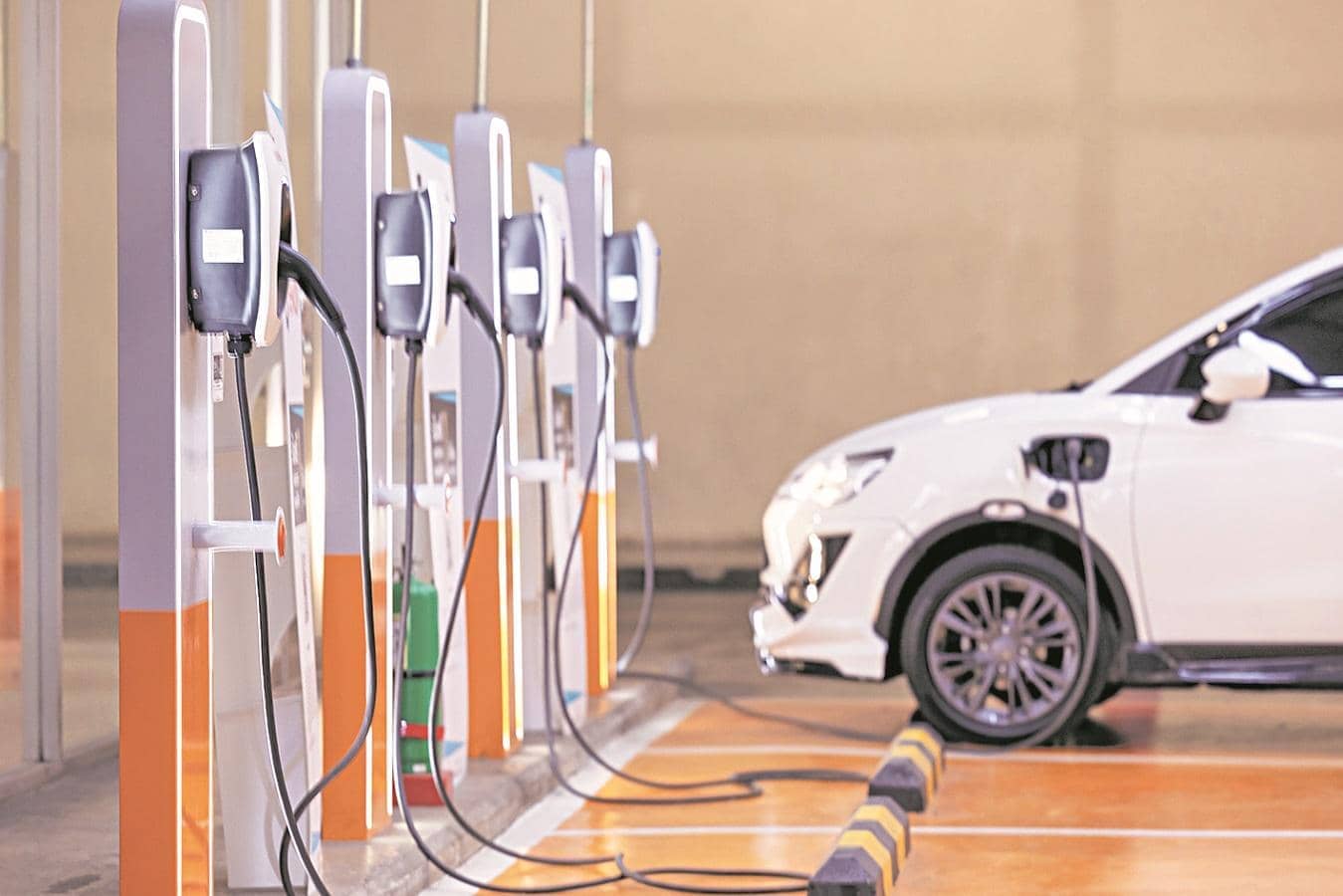
How are charging stations supported?
The policy separately subsidises public charging infrastructure.
A charging station may receive a one-time capital subsidy equal to:
- 20 per cent of eligible fixed capital investment;
- Maximum Rs 10 lakh per station.
The original policy limited this support to the first 2,000 charging stations sanctioned in the state.
A battery-swapping station may receive:
- 20 per cent of eligible fixed capital investment;
- Maximum Rs 5 lakh per station;
- Originally limited to the first 1,000 swapping stations.
One individual, enterprise, company or institution could receive assistance for a maximum of 100 charging or swapping stations under the original framework.
The subsidy becomes available only after the charging or swapping station begins commercial operation.
The state subsequently amended EV-policy provisions in 2025, including aspects of charging infrastructure and EV supply-chain support. Fresh applicants should therefore use the latest government order rather than relying only on the original 2022 limits.
What EV purchase incentives were provided?
The 2022 policy also included early-adoption subsidies for buyers.
The original purchase subsidies were:
| Vehicle | Subsidy |
| Electric two-wheeler | 15% of ex-factory cost, capped at Rs 5,000 |
| Electric three-wheeler | 15%, capped at Rs 12,000 |
| Electric four-wheeler | 15%, capped at Rs 1 lakh |
| Non-government electric bus | 15%, capped at Rs 20 lakh |
| Electric goods carrier | 10%, capped at Rs 1 lakh |
The original scheme also imposed overall vehicle-number and budget limits for each category.
These are adoption incentives rather than manufacturing subsidies.
The Transport Department operates the EV purchase-subsidy portal and remains the nodal agency for buyer-side incentives.
What road-tax and registration benefits apply?
The policy provided a 100 per cent exemption from road tax and registration fees for EVs purchased and registered in Uttar Pradesh during the first three years from notification.
For the fourth and fifth years of the policy, the exemption applies to EVs that are manufactured, purchased and registered in Uttar Pradesh.
This distinction is important as the policy progresses through its five-year period.
The Transport Department’s official EV portal remains the authoritative source for current buyer eligibility and operational procedures.
What other charging-infrastructure measures are included?
Beyond financial subsidy, the policy seeks to improve the commercial viability of charging.
It provides for:
- Strategic identification of charging locations;
- A special electricity tariff for EV charging;
- Fast-track electricity connections;
- Open access for charging or swapping stations with cumulative contracted demand of 1 megawatt or more;
- Battery collection, recycling and disposal infrastructure;
- Coordination among urban-development, power, transport and industrial agencies.
The policy originally aimed to attract at least 20 charging stations and five swapping stations per district during its operative period.
This is a policy target, not evidence that each district has achieved those numbers.
How can a manufacturer apply?
Invest UP is the nodal agency for manufacturing incentives.
The broad process is:
- Identify the applicable manufacturing category.
- Determine the proposed eligible fixed capital investment.
- Apply before commencement of commercial production.
- Submit the project report, investment schedule and financing details.
- Obtain the applicable Letter of Comfort or sanction.
- Complete investment within the Eligible Investment Period.
- Begin commercial production.
- Submit audited investment and asset documentation.
- Demonstrate production and capacity utilisation.
- Apply for the relevant fiscal incentives.
- Undergo documentary and physical verification.
- Receive approved payments through the online incentive-management mechanism.
MSME applications are scrutinised through the district Industries and Enterprise Promotion Centre structure, while Large projects are processed through Invest UP and the Empowered Committee. Mega, Ultra-Mega and Integrated projects undergo scrutiny at a higher-level state committee.
Projects receiving a particular incentive under this policy cannot claim the same incentive under another Uttar Pradesh government policy, although Union government incentives may generally be combined where permitted.
Implementation and current status
The 2022 policy remains officially listed by Invest UP and continues to underpin the state’s EV manufacturing and mobility framework. The official Transport Department portal also remains active for buyer-side EV benefits.
The state amended the framework in 2025 to widen support for parts of the EV value chain and modify charging-related provisions. Official Invest UP material described additional capital support for eligible upstream EV-sector manufacturing projects.
Invest UP’s current EV-sector material also continues to promote capital subsidies, stamp-duty relief, skill incentives, patent reimbursement, certification assistance and industrial land for EV manufacturing.
However, the official sources reviewed do not provide one consolidated public dashboard showing:
- Manufacturing applications received;
- Letters of Comfort issued by category;
- Eligible investment finally commissioned;
- Capital subsidy sanctioned and disbursed;
- Capacity utilisation achieved by beneficiaries;
- Battery-manufacturing capacity commissioned;
- Employment generated specifically by supported manufacturing units.
Investment proposals and announcements should therefore be distinguished from operational manufacturing capacity.
Key challenges and practical considerations
- Capacity-linked subsidy: Large manufacturers need to achieve utilisation thresholds to receive the full annual capital benefit.
- Long reimbursement period: The largest subsidies are paid over ten or twenty years rather than upfront.
- Technology risk: Battery chemistry and EV technology can change rapidly.
- Supply-chain dependence: Cell materials, semiconductors and specialist components may still depend on external suppliers.
- Charging infrastructure: EV adoption depends partly on reliable charging availability.
- Battery recycling: End-of-life batteries create environmental and material-recovery obligations.
- Policy amendments: Investors must verify the latest operational government orders before modelling incentives.
FAQs
What is the highest manufacturing subsidy?
The first two eligible Integrated EV projects and first two Ultra-Mega Battery projects may receive 30 per cent of eligible fixed capital investment, capped at Rs 1,000 crore per project.
What subsidy is available to Mega projects?
The first five eligible Mega EV and Mega Battery projects may receive 20 per cent, capped at Rs 500 crore.
What do Large projects receive?
Large EV and battery projects may receive 18 per cent of eligible fixed capital investment, capped at Rs 90 crore.
Are MSMEs eligible?
Yes. Eligible MSME manufacturing projects may receive 10 per cent capital subsidy, capped at Rs 5 crore.
Is stamp duty reimbursed?
Yes. The rate varies from 50 per cent to 100 per cent depending on project category and location.
Are charging stations subsidised?
Yes. The original policy offered 20 per cent capital subsidy up to Rs 10 lakh per charging station and Rs 5 lakh per battery-swapping station, subject to prescribed limits.
How long is the policy valid?
The original policy is valid for five years from October 14, 2022, subject to subsequent amendments.
Conclusion
The Uttar Pradesh Electric Vehicle Manufacturing and Mobility Policy, 2022 combines large manufacturing incentives with support for charging infrastructure and consumer adoption.
Its strongest manufacturing provision is a 30 per cent capital subsidy of up to Rs 1,000 crore for specified first Integrated EV and Ultra-Mega Battery projects. Mega, Large and MSME projects receive progressively lower rates, while stamp-duty reimbursement, certification, patent and skill incentives provide additional support.
A distinctive feature is the capacity-utilisation mechanism, which ties annual subsidy payments to actual production. The policy’s performance should therefore be judged through factories commissioned, capacity used, batteries and vehicles produced, charging infrastructure operating and incentives actually disbursed—not merely through investment commitments.
Sources
- Uttar Pradesh Electric Vehicle Manufacturing and Mobility Policy, 2022, Infrastructure and Industrial Development Department, Government of Uttar Pradesh; October 14, 2022.
- Uttar Pradesh Electric Vehicle Manufacturing and Mobility Policy, 2022, Invest UP, Government of Uttar Pradesh.
- EV Subsidy Portal, Transport Department, Government of Uttar Pradesh.
- EV Policy and Government Orders, Transport Department, Government of Uttar Pradesh.
- EV Manufacturing Sector, Invest UP, Government of Uttar Pradesh.
- Electric Vehicles Manufacturing, Invest UP, Government of Uttar Pradesh.
What's Your Reaction?
 Like
0
 Dislike
0
 Love
0
 Funny
0
 Wow
0
 Sad
0
 Angry
0











Comments (0)