


Samvat 2083 Begins with Modest Market Moves; Sensex and Nifty Dip Slightly

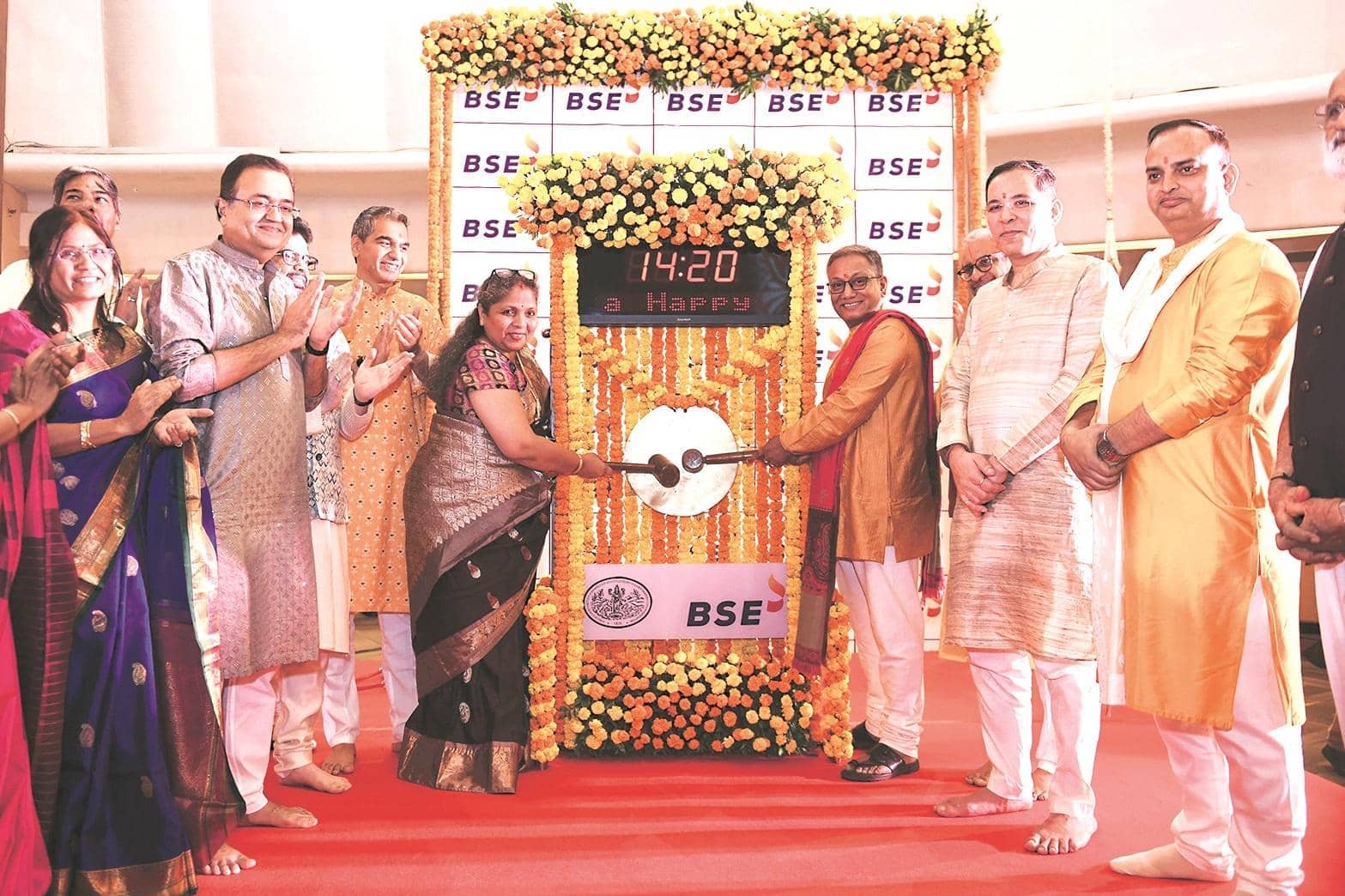


Indian equity markets marked the start of the Hindu new year, Samvat 2083, with a subdued trading session on Sunday. The customary muhurat trading period, lasting one hour, ended with the benchmark indices closing marginally lower, breaking a seven-year streak of gains on this ceremonial day.




The Sensex concluded at 80,999, registering a slight decline of 0.04 percent. Meanwhile, the Nifty 50 slipped 0.18 percent to settle at 24,986. This reversed the trend seen in previous muhurat sessions, as both indices had risen consecutively over the last seven years. The last occasion when these indices ended in the red on muhurat day was October 19, 2017, which marked the beginning of Samvat 2074. At that time, the Sensex dropped 0.6 percent to 32,390, and the Nifty lost 0.63 percent to close at 10,147.
Market participants attributed the tepid performance to profit-taking ahead of the Diwali festival, reduced trading activity due to holidays, and a shortened workweek with a market holiday on Tuesday. Notably, sectors like banking and real estate, which had been strong performers in the previous five sessions, lagged during this special trading window.
In contrast to the large-cap indices, broader market segments showed some resilience. The Nifty Midcap 100 index inched up by 0.1 percent, while the Nifty Smallcap 100 rose by a full percentage point. Market breadth was positive with 2,716 advancing stocks against 736 declines on the NSE. The BSE reflected a similar trend with 3,253 gainers and 937 losers. Sector-wise, the Nifty Pharma, Media, and Healthcare indices ended the session higher, indicating selective strength.
Somil Mehta, head of retail research at Mirae Asset Sharekhan, commented on the market conditions, highlighting the volatility experienced over the last two years, especially in IT and pharma sectors. He mentioned, "The last Samvat was very difficult for the markets, and we are expecting very good market movement in Samvat 2083." He also cited the recent drop in crude oil prices as a positive factor that could ease inflationary pressures, boost corporate earnings, and support market performance in the current year.
The muhurat trading session is an annual event conducted by stock exchanges to celebrate the Hindu new year, coinciding with Diwali festivities. This year, the session was held in the afternoon for the first time, diverging from the traditional evening slot.
On the commodities front, the Multi Commodity Exchange (MCX) saw gold and silver prices dip slightly, while crude oil futures gained over one percent. December gold futures declined 0.02 percent to ₹142,000 per 10 grams, and silver futures for December delivery eased 0.05 percent to ₹185,000 per kilogram. In contrast, November crude oil futures rose 1.13 percent to ₹8,555 per barrel.
Market capitalization of all companies listed on the BSE stood at ₹505.7 trillion by the end of Sunday’s session. On the NSE, the total market cap was ₹499.2 trillion as of the previous session’s close on Friday. Despite the slight dip in benchmark indices, foreign institutional investors (FIIs) displayed strong buying trends, acquiring a record ₹45,960 crore last week, while domestic institutional investors (DIIs) sold ₹24,197 crore.
The key indices had experienced a correction of roughly 15 percent from their April highs, influenced by concerns over slowing corporate earnings growth and uncertainties in US trade policies. Compared to other global markets, India underperformed as investors redirected funds toward other attractive opportunities and sectors focused on artificial intelligence.
Kresha Gupta, director and fund manager at Steptrade Capital, observed that muhurat trading remained relatively quiet despite a strong rally in the prior week. She noted, "As we enter Samvat 2083, the market is increasingly rewarding selectivity over broad-based exposure." Gupta anticipates a gradual recovery in earnings and sustained economic growth this year but expects that investor sentiment will require multiple positive developments to turn decisively bullish. She also suggested that the next wave of wealth creation may come from lesser-known companies with solid fundamentals rather than the largest caps.
In sum, the start of Samvat 2083 saw cautious market sentiment amid holiday trading and profit booking. While headline indices slipped slightly, broader segments and certain sectors showed pockets of strength. Investors will likely watch for economic and corporate earnings updates in the coming months to gauge the market direction in this new Hindu calendar year.
What's Your Reaction?
 Like
0
 Dislike
0
 Love
0
 Funny
0
 Wow
0
 Sad
0
 Angry
0














Comments (0)